Tag: Thoughts

  • The Extra Cost in Dollar Cost Average Investing?

    The Extra Cost in Dollar Cost Average Investing?

    With some spare cash in my current account, I’ve started exploring investing in individual stocks and ETFs more seriously. To begin putting your money into these investments, most investors would have already heard of the lump-sum investing and dollar-cost averaging (DCA) strategies.

    What are they?

    As their names suggest, lump-sum investing simply means investing all your money into an asset at the same time, while DCA means investing smaller amounts of money at regular intervals, over a period of time.

    There are pros and cons to each approach, with a key difference being risk management. According to this Fidelity article:

    [DCA] potentially [helps] reduce the impact of volatility on the overall [asset] purchase. This can serve as a risk management trading strategy if you end up buying more when the price is relatively lower and buying less when the price is relatively higher.

    As I’m uninterested in timing the market (i.e. trying to outsmart other investors by speculating when to buy low and sell high — which in this case would make lump-sum investing a good strategy), DCA sounded like a great strategy as I minimise my transaction risks while I get exposure to the stock markets.

    Andrei Jikh (who’s currently my favourite finance Youtuber) talked about investing US$100 👏🏼every👏🏼day👏🏼 into the VTI and SCHD ETFs here.

    But what’s the catch?

    DCA has a big drawback, especially for retail investors who are looking to invest small amounts of money in regular intervals.

    You could be better off accumulating your money into bigger amounts before investing in longer intervals, e.g. investing $2000 every 2 months, instead of investing $1000 every month. If lump-sum investing and DCA are two ends of a spectrum, the optimal spot for a (risk-averse) investor is at neither ends, and where on the spectrum depends on your own risk appetite. DCA is not a catch-all for the risk-averse because of 💲transaction costs💲.

    When transaction costs come into play

    Depending on the broker you’re transacting your assets through, they have various kinds of fee models. For simplicity, I’m expressing transaction costs as a proportion of the monthly investment amount, so there is no need to consider fees separately (e.g. buying fees, management fees, currency conversion…).

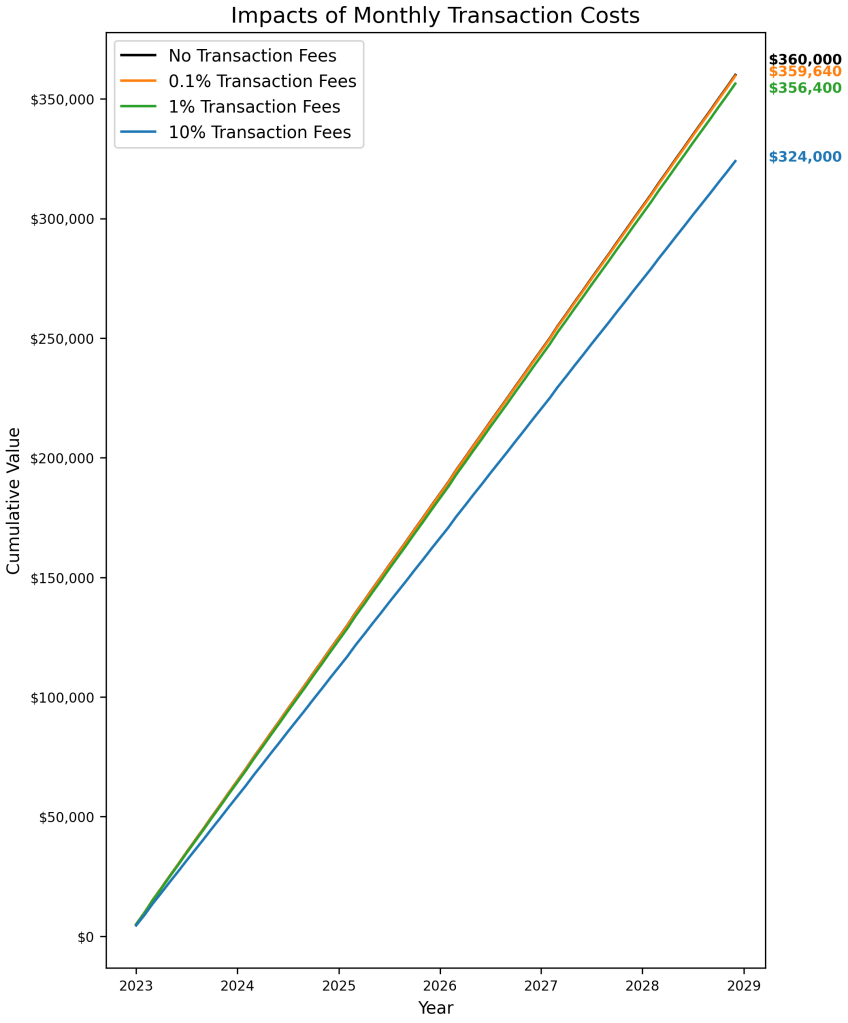
    To visualise the impact of transaction costs, we’ll compare how a portfolio with no cost differs from those with costs. The graph below shows 4 portfolios:

    • Portfolio 1 (in black): The investor invests $5000 every month with no monthly transaction costs. Zero transactional cost will never hold true in reality, so this portfolio is just a hypothetical benchmark.
    • Portfolio 2 (in orange): The investor invests $5000 every month, but with 0.1% of investment value as transaction cost, which works out to be $5 every month.
    • Portfolio 3 (in green): $5000 investment every month, 1% transaction cost, which works out at $50 every month.
    • Portfolio 4 (in blue): $ 5000 investment every month, 10% transaction cost, which works out at $500 every month.
    Difference between portfolios is the percentage-point difference in transaction costs

    By the end of 6 years, Portfolio 1 (with no cost) ended at $360,000, Portfolio 2 (0.1% cost) ended at $359,960, Portfolio 3 (1% cost) ended at $356,400 and Portfolio 4 (10% cost) ended at $324,000.

    In percentages, Portfolio 2 has performed 0.1% worse than Portfolio 1, Portfolio 3 has performed 1% worse than Portfolio 1, and Portfolio 4 has performed 10% worse than Portfolio 1. (Perhaps) Surprisingly, the differences in portfolio performance are the same as the percentage-point differences between the transaction costs.

    In other words, your DCA strategy will perform x% worse than the best hypothetical DCA strategy, and x% is your transaction cost as a percentage of your investment amount at each interval.

    What if I include a principal and projected returns?

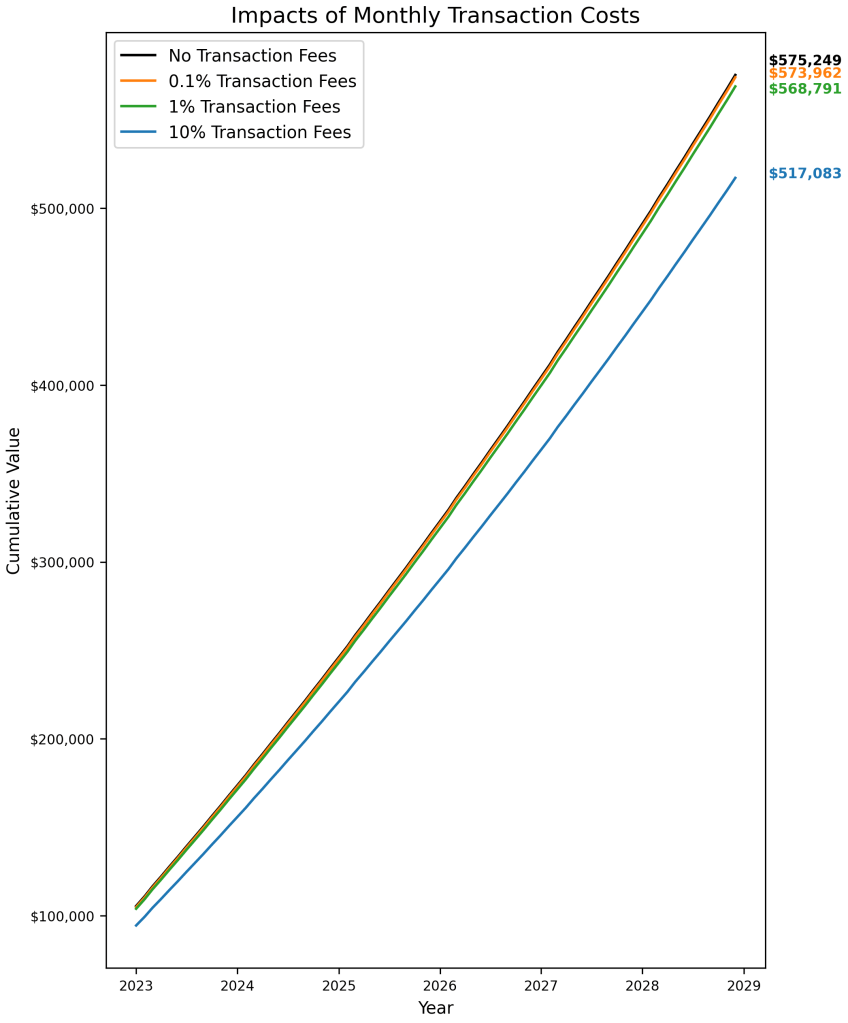
    The previous example assumed $0 initial investment and 0% growth in the money invested. The next graph shows the same portfolios, but with an initial $100,000 investment (also subjected to investment costs), and 6% annual growth in money invested.

    Difference between portfolios is still just the percentage-point differences in transaction costs

    The conclusion stays the same, where the differences in performance is simply the percentage-point differences between the transaction costs of the portfolios.

    Pay attention to your transaction costs

    Given that the key differentiator between DCA strategies is how low we can push the transaction costs as a percentage of the investment amount, it’s crucial to get the correct view of transaction costs each time we make a purchase.

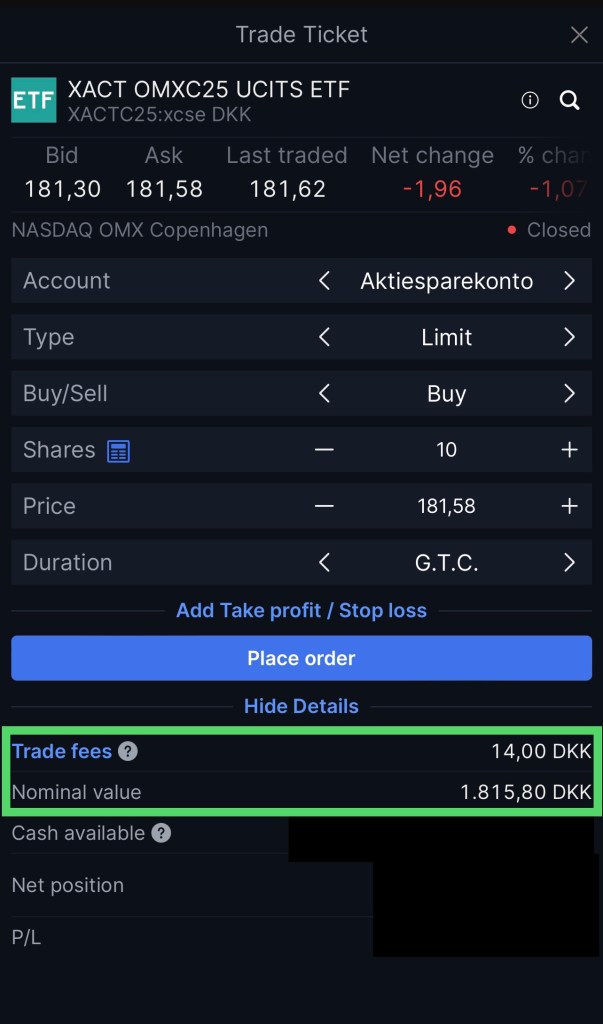
    I can’t speak for all brokerage apps, but this is what I see when I try to buy an ETF through my bank:

    Transaction costs at first glance

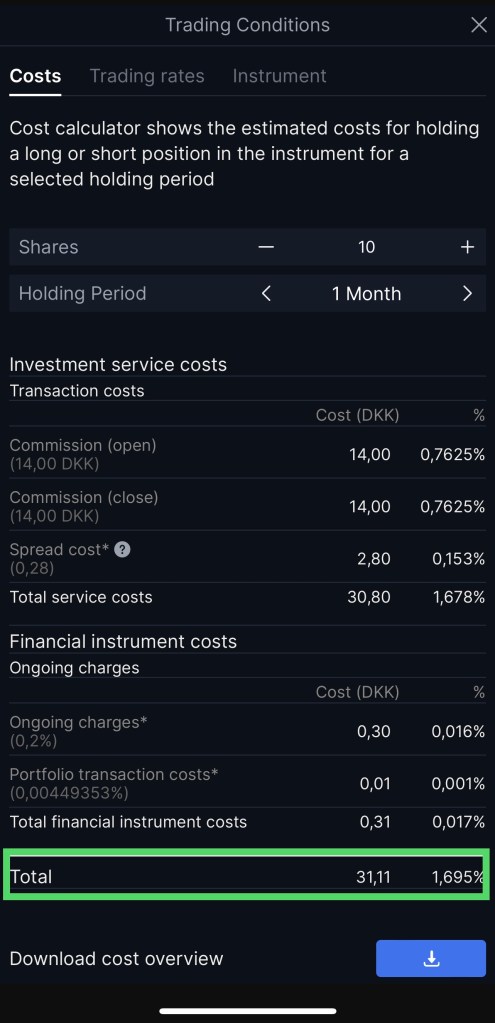
    While it’s tempting to simply calculate my transaction cost here as 14/1815.8 * 100% = 0.771%, a more realistic amount is in fact 1.695%, and arriving at this number involved a few more clicks in the app.

    Transaction costs at second glance

    Another important implication of miscalculating your transaction cost is having a cost-to-investment ratio so high that the investment takes a long time to hit breakeven.

    In a nutshell

    Always consider your transaction cost as a percentage of your total transaction amount at each DCA interval.

    If we consider purely in absolute amounts, while a transaction cost of $5000 might raise alarm bells, we might start thinking that a transaction cost of $10 is acceptable or even cheap. This is not entirely true.

    If a stock costs $100 while you have to pay $10 in transactional cost, this translates to 10% of the investment amount. Consistently paying 10% in transaction costs means losing out substantially to other DCA strategies (which becomes a hefty amount when more money is involved) and the investment having to make 10% before turning a profit.

  • What Is Factor Investing?

    What Is Factor Investing?

    I’ve recently taken a class in CBS on factor investment strategies and I thought it’d be really cool to share some of the results I found while writing a paper. 😎

    I’ve always been interested in investing but I’ve never been a fan of buying stocks (or other investment vehicles) by word of mouth, because they’re trendy or simply based on gut-feel. I’d prefer to do my due diligence: conduct some form of independent research and ascertain the vehicle’s value before buying it.

    But alas, I have zero background in corporate finance, nor do I know how to conduct deep-dives into financial statements, and I don’t have time to regularly pore through companies’ annual reports before deciding what stocks or bonds I’d like to buy.

    So this is where I think factor investing offers a nifty solution.

    Factor Investing

    Very simply put, factor investing involves choosing securities (or just stocks) based on characteristics that are associated with higher returns. Common characteristics include size (buy small stocks), value (buy cheap stocks) and quality (buy good quality stocks).

    What???

    To illustrate, buying stocks based on the size characteristic simply involves calculating the market capitalisation of all companies in the market, then buying the stocks of say, the bottom 30% of companies based on this metric.

    On the other hand, buying stocks based on the quality characteristic could involve calculating the return on assets of all companies in the market, then buying the stocks of the top 30% of companies based on this metric.

    That’s it?

    There is in fact a multitude of characteristics and ways to proxy for these characteristics (briefly discussed here), but they are beyond the scope of this article.

    And how is this a “solution”?

    Choosing stocks based on their characteristics,

    1. satiates my need to conduct fundamental/ quantitative (albeit hasty) research before buying anything, and said research
    2. can be implemented easily over a large number of stocks, which
    3. implies that if I do execute my factor investment strategies, my portfolio is diversified.

    So how well do factor investment strategies perform?

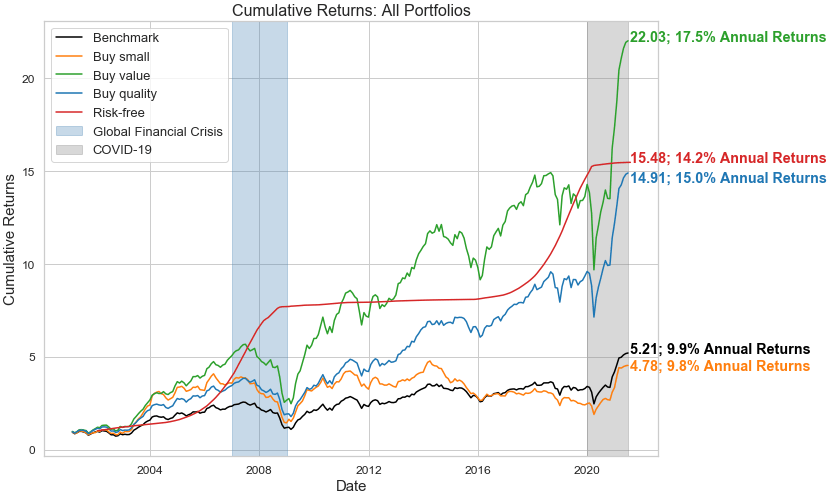
    I’ve chosen to create portfolios of stocks based on the value, quality and size characteristics, and here’s a quick plot of their cumulative returns:

    Cumulative and annualised returns of all portfolios

    The graph above indicates that if you’ve invested $1 into the portfolios built from the value and quality characteristics in 2001, the $1 would have turned into $22.03 and $14.91 respectively in June 2021 🤩. These translate into annual returns of roughly 17.5% and 15.0% respectively. 🤩🤩

    The outcomes would have been markedly different if you had invested $1 into the benchmark portfolio, which is a naive strategy of simply buying every single stock there is in the market, or the portfolio built from the size characteristic.

    All portfolios seem to even be COVID-proof. 😱

    Dataset, the nitty-gritty, and some caveats

    Now that I’ve hopefully gotten your attention, these numbers come with several important notes.

    Dataset

    Related to the dataset:

    1. the graph above is derived from US stocks from January 2001 to June 2021,
    2. the stocks comprise of 15,823 companies that are both still active or have gone inactive, averaging 94 months of available data, and
    3. the dataset is obtained from the Wharton Research Data Services/ Compustat,

    while some important notes concerning my data processing steps are my choices to:

    1. limit return rates to the 99th-percentile return rates of all companies in each month, because some companies report extremely high (and unlikely) monthly returns on certain months and these high values distort my portfolio performances quite significantly,
    2. remove financial firms from the pool of these stocks, and
    3. keep micro-cap stocks in this pool of stocks even though they might introduce complexities such as poor fundamental data quality, with some literature also claiming that they bore little economic relevance.

    Building the portfolios

    Beginning with the simplest, the benchmark portfolio was constructed simply through buying all stocks available in the dataset. Companies can come and go throughout the 20-year horizon, so the basket of stocks that make up the benchmark portfolio can in fact comprise of different stocks month-on-month, over the years.

    The portfolio based on buying small stocks is built by:

    1. computing the market capitalisation for every company on a monthly basis,
    2. ranking all companies by their market capitalisation values, and
    3. buying the bottom 30% companies based on this metric.

    As the market capitalisation is calculated every month, the stocks that make up this “small-stocks” portfolio can therefore also change month-on-month.

    The portfolios based on buying value and quality stocks follow a similar logic, except value stocks involve buying top 30% companies by book-to-market ratios, and quality stocks involve buying top 30% companies by return on assets.

    Are the returns in fact any good?

    If it was so easy to construct these portfolios, where I simply have to buy stocks based on some easily calculated metrics, what’s stopping every other investor from doing the same and then eventually arbitraging away any excess returns that might be associated with these characteristics?

    Indeed, there are loads of literature debating if the size characteristic/ factor still remains, while many assert value and quality’s presence. Regardless, I compare all portfolios to the U.S. 4-week T-Bill rates — where the T-Bill is a relatively risk-free asset — to test if my actively managed portfolios are able to outperform an asset that requires relatively less investor involvement and entails lower risks.

    Cumulative and annualised returns of all portfolios, with risk-free asset

    As the line in red suggests, consistently investing in the T-Bill could yield similar to much better returns than just simple factor investing.

    In sum

    I’ve barely scratched the surface of factor investing, and there are in fact countless other nuances that could be considered. On top of various other characteristics/ factors, there are different ways to proxy for these characteristics, different ways of weighing the returns of each stock in every portfolio, and even the possibility of combining short-selling and going long on stocks, instead of the long-only portfolios that I have described.

    Nonetheless, I think this exercise was a pretty good prelude either to fundamental analysis, to fancier combinations of factor investing, or simply a reassurance that sometimes risk-free assets are the way to go for the uninitiated. 😅

  • The Dream Conundrum

    The Dream Conundrum

    Sometimes it really gets to you — you see your friends get attached, married, apply for housing, have kids and you think to yourself,

    “wouldn’t that be a much easier road to contentment?”

    It’s probably not the best thing to proclaim but I guess I’ve always been pretty lazy. I usually work hard to find the easiest and/ or fastest way out of my assignments so in terms of convenience, the Singaporean Dream always seemed like a very alluring, easy option.

    Study hard, get a good job, find a nice partner (or not), own a home, invest in something, go for holidays twice a year, (maybe) have some (fur)kids (and when you do, be sure to have them take over your social media :P), and voila! A great, fulfilling life hopefully happily ever after.

    I’ve been fed that narrative through many positive examples: my parents have been married for aaaaages, own a decent flat, brought me up fine, while too many friends are pairing up (too many because I forked out too much money for a lot of your pair-up rituals and they barely even concern me but hey I’m happi for u :P) and of course, they seem really happy on social media doing things together. I’d like to think that the Singaporean media and our public policies also pulled no punches with promoting and making it very conducive to subscribe to the Singaporean Dream; so for the most part, as far as what I’ve observed goes, I think it’s awesome!

    The disconcerting thing about aspiring towards the Singaporean Dream though, is it really isn’t as linear as I thought it’d be, and definitely not that all-encompassing. 

    Along the way things happen and change: you fall in and out of love, you develop alternative, lofty dreams of your own that scare you as much as they excite you, you meet like-minded people whose ambitions are as great as yours, but their trajectories will ironically diverge from you as you all aspire towards different goals. You realise that while Singapore is great, the world is huge with many other ways of life… And as soon as you know it, the Singaporean Dream no longer suffices and perhaps also in some other ways, doesn’t align with you anymore.

    You come to an awakening that your life is far, far different from a typical 喜临门 or 荷兰村 plot where if you toil hard enough, the Sun shines again, everything magically resolves itself by episode 25 or 100, the villains get their comeuppance, everybody congratulates each other and live happily ever after. (As much as I understand that these are really just stupid soap operas, you unwittingly buy in to some of their ideals when you watch enough of them.)

    I guess my point is: the dissonance between the Singaporean Dream narrative in my head and my reality has been pretty hard to stomach lately, and I don’t know how to feel about it. As amazing as it sounds to settle down/ find companionship, buy a house and call it a day, you begrudgingly hold back because you understand that (1) it’s really unfair to subject someone to your own volatilities while you chase your dreams or sort your priorities out, (2) the dream-chasers you’re attracted to and you might all find it more convenient to chase your dreams separately and (3) you’ve heard too many horror stories of failed partnerships.

    Sigh GIF - Find & Share on GIPHY

    I have no motivational banger to end this entry because I have no clue. I can only hope that in time, my (and your, if you find yourself in the same predicament) priorities get straightened, that we have the courage (again) to commit ourselves to a project or someone who enjoys your company as much as you enjoy theirs and ultimately reach contentment, Singaporean Dream or not.

  • This Whole Gay, Straight, Bi Thing

    This Whole Gay, Straight, Bi Thing

    Recently I have had conversations with my friends regarding people and having friends from the LGBTQ community and about potentially having LGBTQ children. 

    Some of us think there is absolutely nothing wrong or offensive about being LGBTQ, while some of us don’t understand how can same sex attraction occur and hold on to more conservative views/ beliefs. 

    What pains me the most during some of our discussions is the fact some of us do not hesitate to use extremely divisive terms like, “disturbing”, “disgusting” and “retarded” in describing people from the community. And many a times, sentiments like that arise very simply from a lack of empathy. “I don’t understand why would a girl/ guy be attracted to another girl/ guy.” “Why would a man be interested in having sexual relations with another man, that’s disgusting.” 

    Actually, there is really not much to understand except one thing: that you cannot actively control your attractions, straight or not.

    A few of my straight friends have also described to me their experiences in gay clubs. These experiences would usually be along the lines of them feeling uncomfortable with the surge of attention from people of the same sex. At some points their descriptions actually sounded dehumanising, as though the gay club-goers were desperate, ravenous maniacs who couldn’t wait to tear through their virgin flesh. 

    Either my friends were exaggerating their experiences or they were really attractive because the last I hear, people – straight or not – have tastes and preferences.  

    Assuming my friends did in fact have very disturbing and unwanted encounters in the gay clubs, desperate, ravenous and promiscuous behaviours are not restricted to homosexuals, anyone can exhibit these behaviours. Just ask a girl who has been to a club that heterosexuals go to. Or ask a really rich guy. 

    In all honesty though, an opinion is after all just an opinion. They are empty. If you firmly have very negative feelings about the LGBTQ community but the most you would do is to have nothing to do with them, this is fine.

    But when those thoughts crystallise into something sinister, like the acts of violence against the LGBTQ community, this is not okay.

    It is extremely unfair to severely restrict someone else’s life chances or subject them to physical harm just because you, as part of the majority heterosexuals, “do not understand” a part of their being. So really, we can have an endless discussion about how acceptable it is to be LGBTQ, but understand that people with alternative sexualities are humans too, that they are present and that they deserve the same rights and opportunities as the straight majority.