Category: Thoughts

  • Managing My Finances as an Expat

    Managing My Finances as an Expat

    As a Singaporean living and working in Denmark, having bank accounts, savings and expenses both in Denmark and Singapore have made tracking my finances somewhat complicated.

    Money gets transferred across geographies… I earn, save and spend across different accounts… and waters get even muddier when I no longer just keep cash in the bank, but also invest in stocks and bonds.

    What are people saying?

    I knew I had to keep a close eye on my finances. Quick Googling suggests these for emergency funds and holding cash:

    • Emergency fund: Keep 3 to 6 months’ worth of essential living expenses in a liquid savings account.
    • Portfolio cash: Limit general cash or cash equivalents to roughly 2% to 10% of your total investment portfolio unless you have a major purchase planned within 12 to 24 months.

    CNBC also recommends retirement benchmarks by decades:

    • Age 30: 1x your annual salary
    • Age 40: 3x your annual salary
    • Age 50: 6x your annual salary
    • Age 60: 8x your annual salary
    • Age 67: 10x your annual salary

    But my numbers were everywhere in different accounts, different currencies, and they fluctuate depending on market conditions. I usually only had a hunch of how much I made and how much I spent, but nothing precise about my net-worth.

    How do I get an overview of everything?

    I started with a simple Excel file that slowly got more complicated. And I’m sharing a simple version of my Excel file in this post.

    I’ve used it over a few years. It has kept me on my toes all this while, and I get to do extra shopping 🛍 or have a couple extra takeouts 🥡 without guilt when I can see that I (or mostly the market) have made a good month of savings.

    In adult (and boring) terms, I could also start having clearer ideas and projections about when a home or big-ticket purchases become plausible, with such an overview.

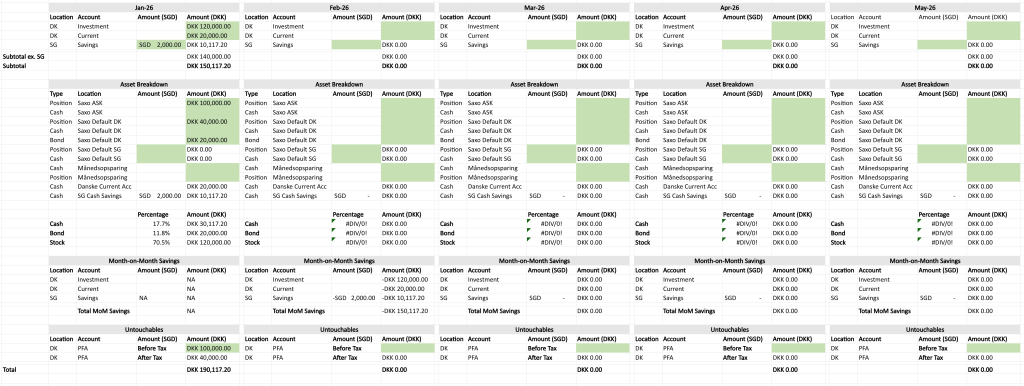
    The Excel file looks like this:

    And it’s available ✨ here

    What are we looking at?

    From left to right, I track my finances at the start of every month, so 12 repetitions of the same set of cells for a whole year.

    From top to bottom, I start with a quick glance of all my money across my 3 accounts (2 in Denmark, 1 in Singapore), before diving into the breakdown across all these accounts.

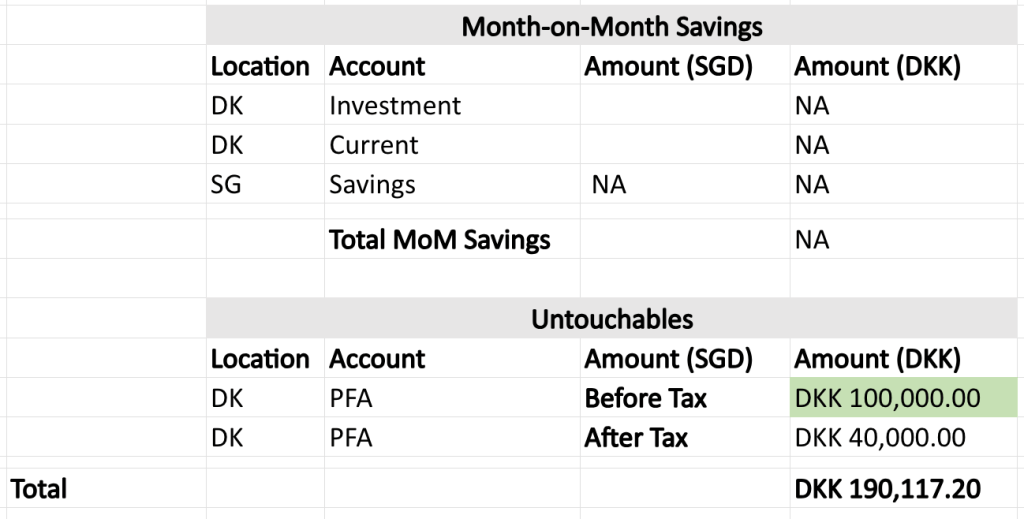
    Month-on-month savings show the savings (or losses) made from the current month to the previous month. Untouchables is money I have in my Danish pension that is not immediately available, hence the name.

    I have accounts in 2 currencies, hence the SGD and DKK columns, and I eventually sum them up in DKK, since I’m financially more active in Denmark.

    The Quick Overview

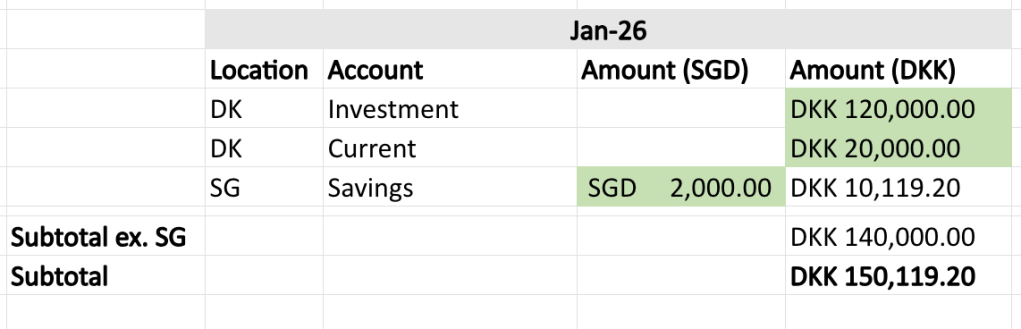
    Each row is just the amount of money I have in each of my bank account. The green cells are where I input amounts of money, either in SGD or DKK, and they get summed up automatically in DKK in the subtotal rows.

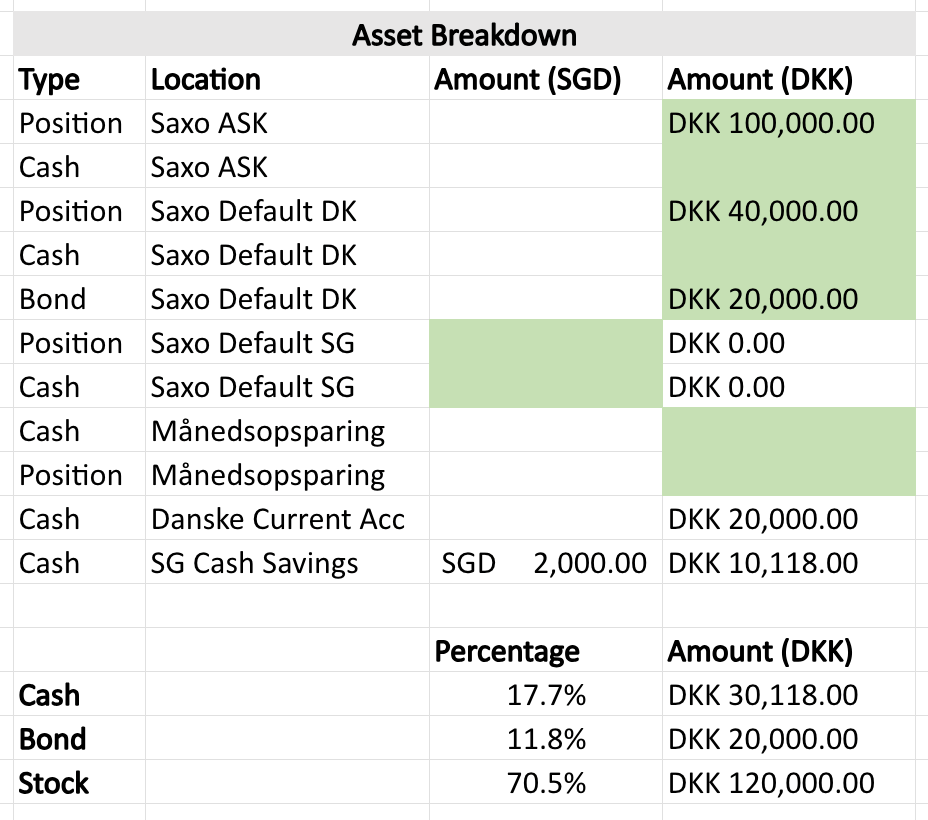
    Asset Breakdown

    The breakdown gets a bit more interesting. This depends on brokerages, but the brokerage that I’m using lets me see values in different sub-accounts I have with them, differentiated by cash and positions held.

    Each row represents the type of asset I have in each sub-account and the value of them. A slight complication here: I need to know the breakdown across my cash, stocks and bonds, but my brokerage doesn’t explicitly show the breakdown between the values of stocks and bonds I own.

    I’ve therefore chosen to record whatever I see from my brokerage app under cash and position –where position is the sum of both stock and bond values — and then record my bonds’ value in a different row to separate them out from the stocks in the next calculations.

    I then calculate the percentage breakdown of my assets for the month. From this I get to see if I’m holding too much cash based on the 3-6 months of expenses recommendation or owning too many shares for my own risk appetite.

    The Rest

    Month-on-month savings shows how much value in each account changed from the current month to the last month.

    Untouchables describe the amount of money I have in my pension in Denmark. If I do choose to permanently leave Denmark before retirement age, I receive the money after paying taxes, hence the before and after tax rows. The last row describes the total amount of money that is mine (but also not really mine yet).

    Add-ons

    This file is the simplest version for how I keep an overview of all my money across different accounts and currencies. It’s a fairly simple exercise to add more rows if you have more accounts, and more columns if you deal with more currencies.

    In my own copy, I’ve also tried gamifying the process. I added quarterly goals at the start of each quarter and reminders for myself how much “work” needs to be done in the next months to hit my targets.

    Caveats

    I’ve seen other content creators deciding to exclude unrealised gains and losses as part of their tracking. That exercise however is too cumbersome and less meaningful to me, as I still use the month-on-month movements to decide how much or less to invest.

    I currently also have no debts, so I have not accounted for any.

    An even better overview?

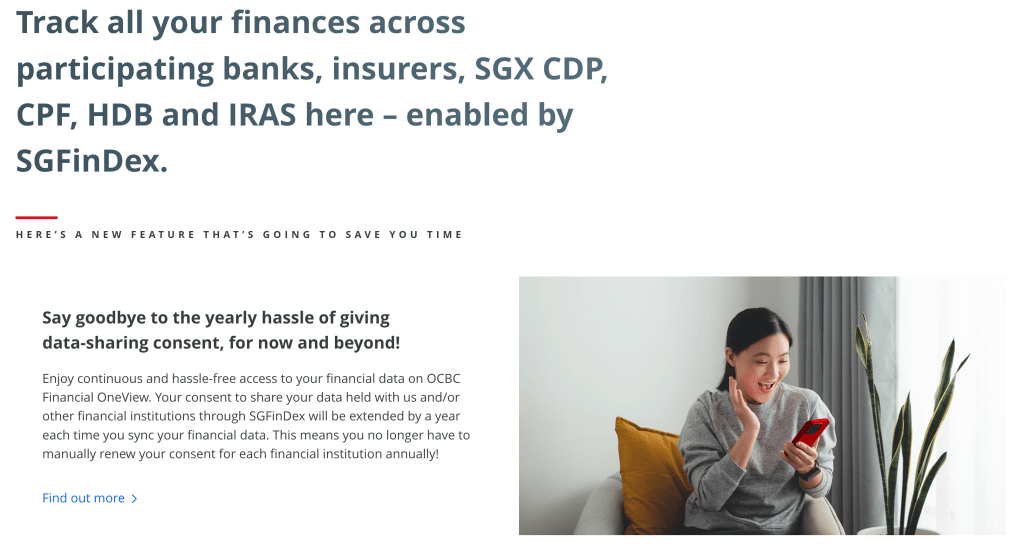
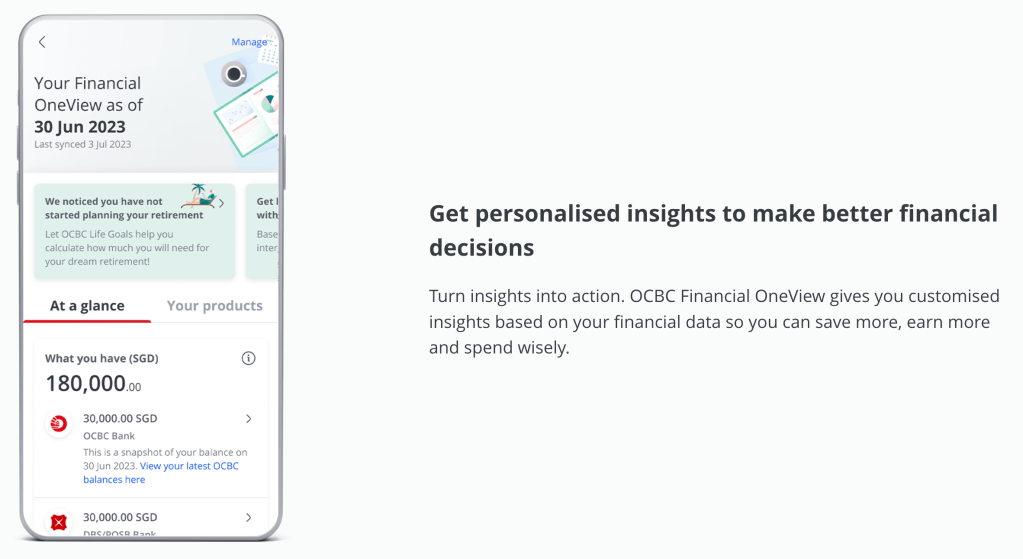
    My process is still a highly manual one, and I would ideally love to have an app that can automatically tap into my bank accounts and give me a customised view of my assets. In fact, it sounds like Singapore already has one (OCBC OneView):

    And it sounds amazing, with overviews not just on net-worth based on cash and stock market positions, but also insurance policies, home loans, taxes…

    For the Singaporeans using the financial OneView, how is that going for you?

    Is there a Danish version?

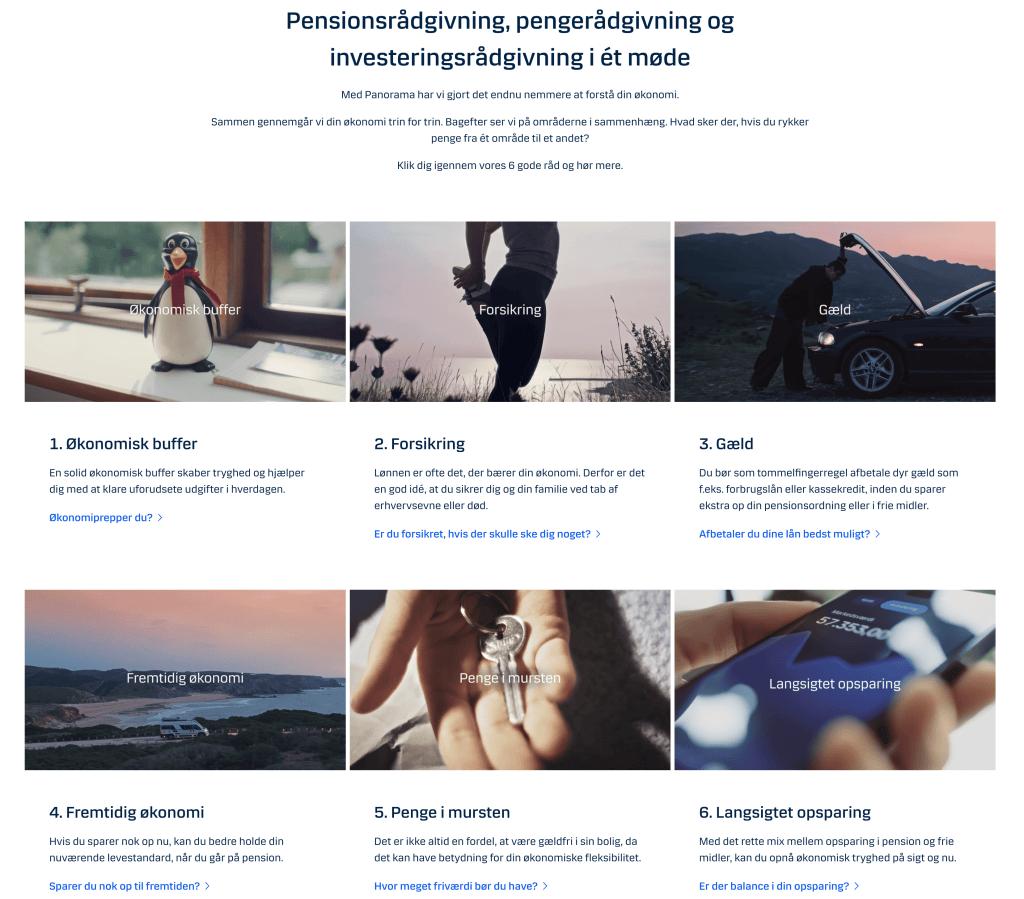
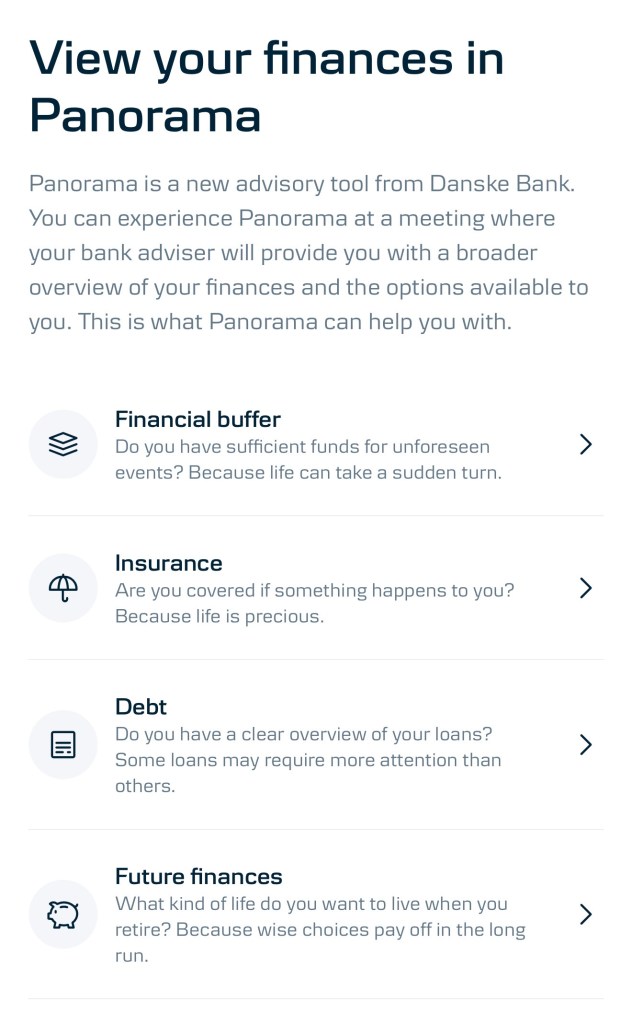
    I’ve heard about the Panorama tool by Danske Bank, and it reads like it’s a financial advisory tool for them to recommend optimising asset allocation, loan structuring, future planning etc., more than a financial tracking tool just for keeping an overview.

    Thoughts if you’ve used it? 🧐

    In sum

    I’ve been tracking my finances, the process works for me, but it could be so much better. If you’re new to the process, feel free to use the Excel file shared above. If not, I’d love to hear what your process is and if there’s something I’m missing out on, especially in the Danish context, I’d love to hear your thoughts. 🤩

  • The Extra Cost in Dollar Cost Average Investing?

    The Extra Cost in Dollar Cost Average Investing?

    With some spare cash in my current account, I’ve started exploring investing in individual stocks and ETFs more seriously. To begin putting your money into these investments, most investors would have already heard of the lump-sum investing and dollar-cost averaging (DCA) strategies.

    What are they?

    As their names suggest, lump-sum investing simply means investing all your money into an asset at the same time, while DCA means investing smaller amounts of money at regular intervals, over a period of time.

    There are pros and cons to each approach, with a key difference being risk management. According to this Fidelity article:

    [DCA] potentially [helps] reduce the impact of volatility on the overall [asset] purchase. This can serve as a risk management trading strategy if you end up buying more when the price is relatively lower and buying less when the price is relatively higher.

    As I’m uninterested in timing the market (i.e. trying to outsmart other investors by speculating when to buy low and sell high — which in this case would make lump-sum investing a good strategy), DCA sounded like a great strategy as I minimise my transaction risks while I get exposure to the stock markets.

    Andrei Jikh (who’s currently my favourite finance Youtuber) talked about investing US$100 👏🏼every👏🏼day👏🏼 into the VTI and SCHD ETFs here.

    But what’s the catch?

    DCA has a big drawback, especially for retail investors who are looking to invest small amounts of money in regular intervals.

    You could be better off accumulating your money into bigger amounts before investing in longer intervals, e.g. investing $2000 every 2 months, instead of investing $1000 every month. If lump-sum investing and DCA are two ends of a spectrum, the optimal spot for a (risk-averse) investor is at neither ends, and where on the spectrum depends on your own risk appetite. DCA is not a catch-all for the risk-averse because of 💲transaction costs💲.

    When transaction costs come into play

    Depending on the broker you’re transacting your assets through, they have various kinds of fee models. For simplicity, I’m expressing transaction costs as a proportion of the monthly investment amount, so there is no need to consider fees separately (e.g. buying fees, management fees, currency conversion…).

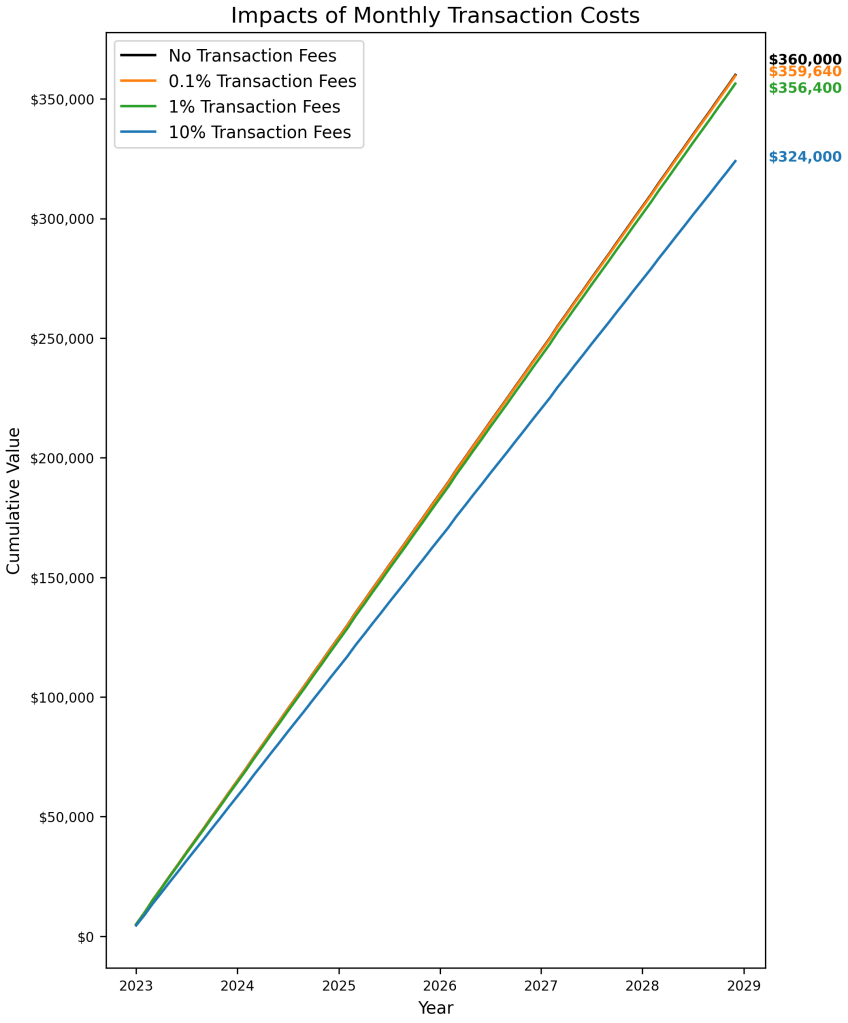
    To visualise the impact of transaction costs, we’ll compare how a portfolio with no cost differs from those with costs. The graph below shows 4 portfolios:

    • Portfolio 1 (in black): The investor invests $5000 every month with no monthly transaction costs. Zero transactional cost will never hold true in reality, so this portfolio is just a hypothetical benchmark.
    • Portfolio 2 (in orange): The investor invests $5000 every month, but with 0.1% of investment value as transaction cost, which works out to be $5 every month.
    • Portfolio 3 (in green): $5000 investment every month, 1% transaction cost, which works out at $50 every month.
    • Portfolio 4 (in blue): $ 5000 investment every month, 10% transaction cost, which works out at $500 every month.
    Difference between portfolios is the percentage-point difference in transaction costs

    By the end of 6 years, Portfolio 1 (with no cost) ended at $360,000, Portfolio 2 (0.1% cost) ended at $359,960, Portfolio 3 (1% cost) ended at $356,400 and Portfolio 4 (10% cost) ended at $324,000.

    In percentages, Portfolio 2 has performed 0.1% worse than Portfolio 1, Portfolio 3 has performed 1% worse than Portfolio 1, and Portfolio 4 has performed 10% worse than Portfolio 1. (Perhaps) Surprisingly, the differences in portfolio performance are the same as the percentage-point differences between the transaction costs.

    In other words, your DCA strategy will perform x% worse than the best hypothetical DCA strategy, and x% is your transaction cost as a percentage of your investment amount at each interval.

    What if I include a principal and projected returns?

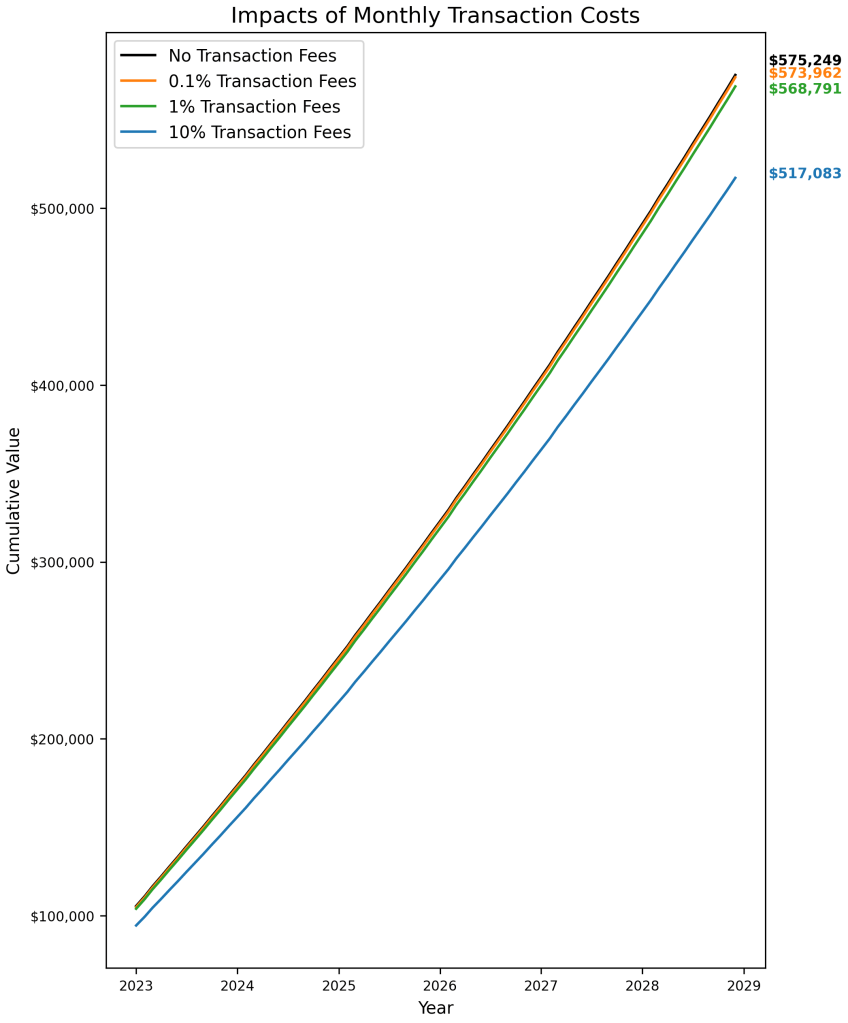
    The previous example assumed $0 initial investment and 0% growth in the money invested. The next graph shows the same portfolios, but with an initial $100,000 investment (also subjected to investment costs), and 6% annual growth in money invested.

    Difference between portfolios is still just the percentage-point differences in transaction costs

    The conclusion stays the same, where the differences in performance is simply the percentage-point differences between the transaction costs of the portfolios.

    Pay attention to your transaction costs

    Given that the key differentiator between DCA strategies is how low we can push the transaction costs as a percentage of the investment amount, it’s crucial to get the correct view of transaction costs each time we make a purchase.

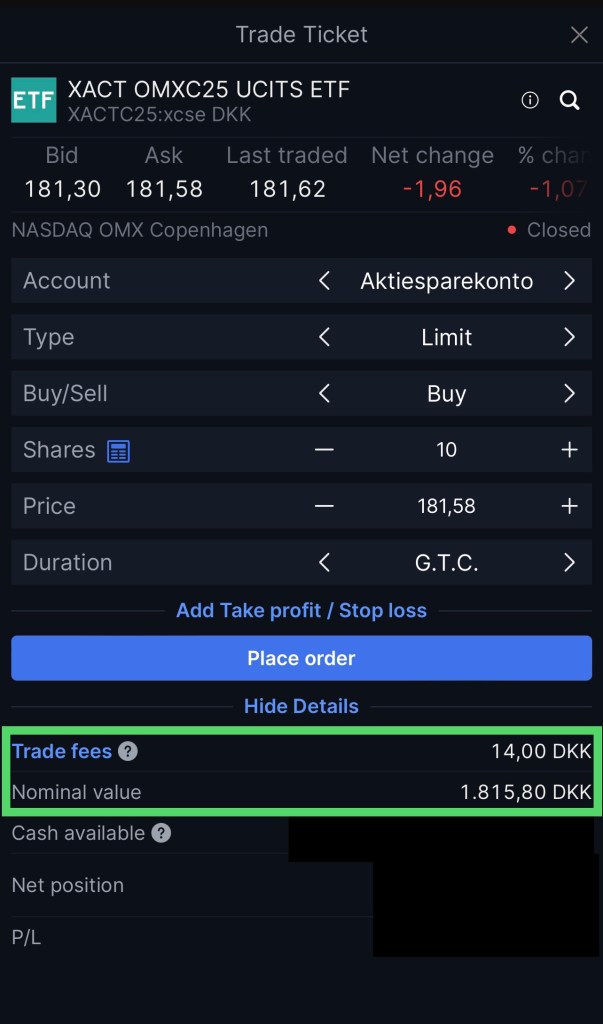
    I can’t speak for all brokerage apps, but this is what I see when I try to buy an ETF through my bank:

    Transaction costs at first glance

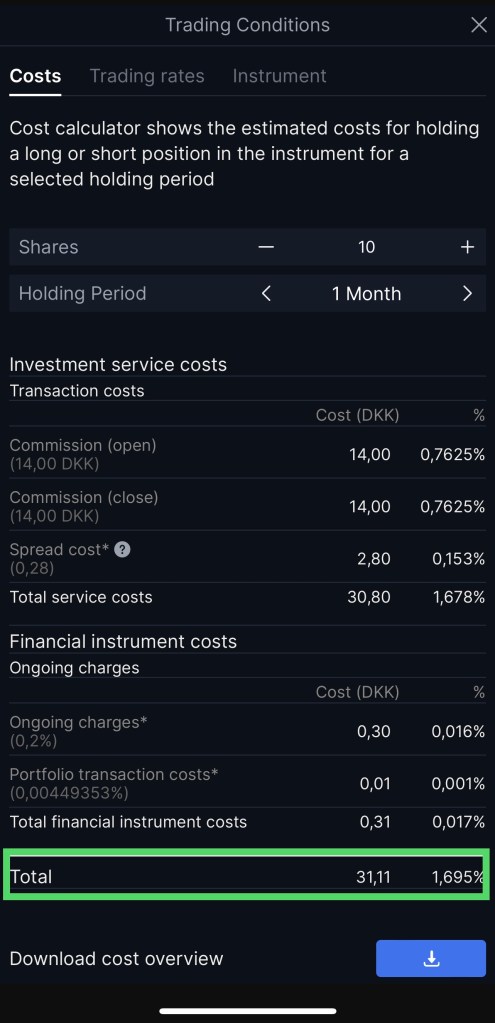
    While it’s tempting to simply calculate my transaction cost here as 14/1815.8 * 100% = 0.771%, a more realistic amount is in fact 1.695%, and arriving at this number involved a few more clicks in the app.

    Transaction costs at second glance

    Another important implication of miscalculating your transaction cost is having a cost-to-investment ratio so high that the investment takes a long time to hit breakeven.

    In a nutshell

    Always consider your transaction cost as a percentage of your total transaction amount at each DCA interval.

    If we consider purely in absolute amounts, while a transaction cost of $5000 might raise alarm bells, we might start thinking that a transaction cost of $10 is acceptable or even cheap. This is not entirely true.

    If a stock costs $100 while you have to pay $10 in transactional cost, this translates to 10% of the investment amount. Consistently paying 10% in transaction costs means losing out substantially to other DCA strategies (which becomes a hefty amount when more money is involved) and the investment having to make 10% before turning a profit.

  • Fillers, Lasers and All That Fun Stuff

    Fillers, Lasers and All That Fun Stuff

    I’ve spent way too much money and time on my skin to not talk about it, and I’m writing this to hopefully save you some efforts. So if you’re like me, on a R E L E N T L E S S pursuit for the best skin possible, strap in because it’s going to be a long but good one.

    Background of my skin

    In Singapore’s climate I’ve had very oily skin and *anybody* who knows me agrees.

    I tread a veeery fine line between dewy and overdewing it
    I dunno I just think this is a cute photo of me

    My acne condition fluctuated since I was 14, got to its worst around 18 – 19 and reached equilibrium around 23. I have to clarify though that I don’t have bad skin — I don’t recall ever having more than 5 concurrent, active cystic pimples even at my worst.

    this is somewhat as bad as my skin gets; I don’t have an accurate picture of my condition when I was 18 – 19

    The biggest problem with my skin is if I get a pimple, it takes a disproportionate amount of time to go away. It’s primarily because of post-inflammatory erythema (PIE) or post-inflammatory hyperpigmentation (PIH). The discolouration from a pimple typically takes months to completely disappear and recently I’m wondering if my remaining ones will even go away without external help.

    Because each pimple (or its residual dyspigmentation) takes so long to completely disappear, I usually develop a new pimple before the old one goes away. So despite having few active pimples, my skin can look worse than it feels. Over the years though, my past acne had unfortunately left some scars.

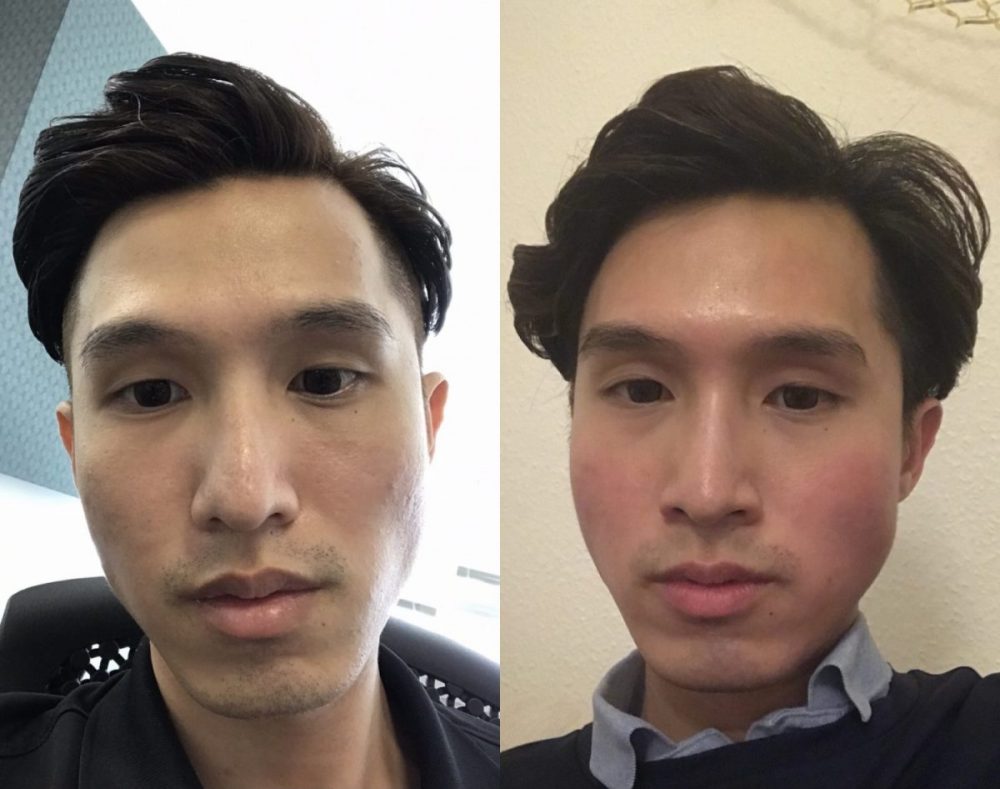
    (Slight) scarring on my cheek bothers me the most (right of this photo)
    Again, my cheek, right of this photo

    Things being said, the issues I’ve always been very adamant — borderline irrational — about fixing are levelling my pitted scars, lightening my dyspigmentation and more recently, keeping my sebum production (oiliness) under control.

    What have I done and did they work?

    I’ve used and done far too many things. I’ve had subcision (with and without fillers), chemical peels, and fractional CO2 (or its variants), INFINI and CoolTouch lasers done as medical procedures. I’ve used most kinds of exfoliating acids (AHA, BHA, glycolic…), tretinoin (and its variant adapalene) and various other run-of-the-mill substances (vitamin C, hyaluronic acid…) as part of my skincare routine. I’ve also gone to beauty salons for extraction and other (gimmicky) treatments.

    Having done all these things, I actually think the doctors themselves and the routines or the protocols they introduce might be more important than the procedures or products being used.

    For my skin, Niks Maple‘s recommendation was the most robust routine of topical products to control my acne condition, while Sozo Aesthetics provided the most satisfactory protocol of medical procedures to revise my scars.

    Clarification 1: topical treatment

    I went to Niks Maple at my friend’s recommendation when I was 18 and I was prescribed a whole suite of topical products. This varied depending on my skin condition during each visit but it largely follows this routine: facial cleanser, a variant of some serum or toner, glycolic acid in varying concentration, moisturiser, tretinoin (0.025%, 0.05% or 0.1%), some facial oil and sunscreen. They also prescribe antibiotics (dalacin T or clindamycin) or spot treatments (epiduo — adapalene + benzoyl peroxide or some other in-house variant) depending on the severity of my acne condition when I visit. All these were many years ago so my information could be outdated.

    I think their routine is robust because they:

    1. introduced me to the most effective products in general skincare and in combating acne, namely:
      • glycolic acid (holy grail 1), tretinoin (holy grail 2), clindamycin (which I no longer use) and epiduo (for the occasional spot), and
    2. I still broadly follow their recommended routine of applying products.

    But because of costs and personal preferences, I only use tretinoin (0.05% — Galderma), glycolic acid (12% — in-house formulation) and epiduo (Galderma) from them now.

    Clarification 2: medical procedures

    Because I am impossibly nit-picky and no topical treatment is going to satisfactorily treat my atrophied scars, I sought out medical procedures to revise them. Before Sozo Aesthetics, I was prescribed subcision, chemical peels, fractional CO2 (of varying strengths) and CoolTouch lasers… but they just felt very haphazardly prescribed and performed. These treatments are acclaimed so they should have yielded some (good) results, but I still felt that there was room for improvements.

    Could be improved

    Justin Boey from Sozo Aesthetics on the other hand, described a very systematic approach to his treatment plan. He recommended in each session, a combination of:

    1. subcision (with or without fillers) to free and plump my skin from underlying scar tissues,
    2. INFINI laser to treat deeper dermal layers of my skin, and
    3. fractional CO2 laser to treat more superficial layers of my skin.

    Disclaimer: I have deliberately described these procedures in brief because I am no medical expert. Read here, here and here for more details.

    These were done in monthly intervals over a number of sessions depending on your budget. I went for the maximum (8) because this was a “last-ditch effort” at giving myself closure, that I’ve done absolutely everything for my skin if this still turned out unsatisfactory.

    Ultimately, I cannot causally identify the efficacy of each procedure or product because they were (1) performed and used in combination, (2) over different periods of time. Any econometrician (ha-ha) will tell you that there are too many confounding factors at play here. My skin can however, attest to the efficacy of these things collectively. I have to caveat though that the Danish weather has treated my facial skin favourably — I’ve produced less sebum and sweat here — and I’m also low-dosing isotretinoin, which targets limiting sebum production.

    6th Feb 2021; fresh out of bed
    before 6th Feb 2021; after some time out in the cold with more redness

    You can decide if the results are discernible enough. I’m satisfied with the texture of my skin and I suspect the remaining scarring appearance has more to do with dyspigmentation than actual atrophy.

    Red flags

    Any medical aesthetics clinic or beauty salon can recommend treatments that promise to treat your acne scars. But as mentioned before, it is to your detriment if they are haphazardly prescribed or performed, e.g.:

    • if doctors prescribe only sporadic/ one-off treatments with no clear medium to long-term plan nor past results to show you, or
    • non-medically certified beauticians who might use inadequately powered devices or iffy techniques to conduct your treatments. (I had the experience of having my spots consistently skipped by these beauticians during treatments for fear of worsening them — why am I paying these people for treatment then?)

    If you expect radical improvements to your skin, especially for acne scarring, my personal take is simply to find a well-reviewed medical professional for treatments and avoid non-medically trained beauticians.

    Separately, I’m also not a fan of influencer marketing regarding skincare. My main gripe is many influencers are likely unable to provide clear, causal and quantifiable evidence of the individual efficacy of the products or services that they’re promoting. It’s even more likely the case if they’re promoting different products within short periods of time based on anecdotal experience.

    Concluding remarks

    As you can tell, I clearly have an (unhealthy) obsession with skincare and treatments. It was part of my plan to go for Pico laser, but hey Copenhagen happened, and Pico lasers here are more targetted at tattoo removal than treating dyspigmentation. Either way, I hope my long exposition has helped or informed you somewhat and feel free to reach out below if you have other questions!

  • How I Landed a Full Scholarship with Copenhagen Business School

    How I Landed a Full Scholarship with Copenhagen Business School

    I’ve always known that I was going to apply to a Master’s program at some point.

    I graduated from the National University of Singapore (NUS) back in 2017 and majored in economics. My interests lied in the intersection of quantitative and applied economics — applied econometrics, time series analysis, financial economics… all that fun stuff. But despite my interests, I’ve never had an affinity for any particular industry. I liked finance but I didn’t mind joining the Singaporean public sector; I wouldn’t mind a job in retail customer analytics, but research in labour market outcomes could be fun too. So two things became clear to me:

    1. if job opportunities that involved rigorous data-related work were to come around, I’d most likely take a second look, but
    2. my training in economics was insufficient for such work in the business/ commercial realm.

    So I had to study again but more importantly, I also wanted to study again.

    What, when and where to study?

    “What” and “when” were in fact pretty straightforward: I knew I wanted data science or business analytics, and I would ideally like to enrol ASAP. “Where” on the other hand, was trickier considering tuition fees, and many other additional costs if I were to enrol abroad, which I was actually very inclined towards.

    Master’s programs available to a Singaporean like myself are prohibitively expensive. So programs, schools and geographies aside, I also had to consider funding options and opportunities. I considered the US, the UK, Denmark, the Netherlands, Hong Kong… but my options quickly narrowed because very few schools offered partial scholarships, much less full ones. At the time of my application, the only other school besides Copenhagen Business School (CBS) that I had found to offer full scholarships for Master’s is Stanford. But with more research, DTU, ITU and KU in Denmark in fact also offer full scholarships for non-EU/ EEA students.

    This then begs the questions:

    Why CBS and what did I do for the scholarship?

    Master’s programs have (nuanced) differences between them even if they have the same title. This depends on the school that’s offering the program. An engineering or technical school offering data science will likely focus on theoretical content with heavier emphasis on research, while a business school is likely to deliver with more focus on application and industry collaborations. I knew from the outset that my interest was in the application of data tools in the business realm so CBS was a clear choice for me.

    CBS structured their Master’s application such that the motivation for your program choice and your scholarship application are all written together in a 2-page document. Full details of the application steps and guidelines are available here.

    Tip 1: Optimally structure your personal statement

    While CBS provided a list of pointers to help you craft your personal statement — which meant that you should minimally answer every point on the list — I was relatively clueless about how I should structure my statement. As advised by my mentor (thank you, Jessica!), because candidates usually apply to multiple schools, the first half of my statement should be a personal story and this part should be independent of the school that I was applying to. I would only need to amend the latter half of my statement for every application I sent.

    With her advice, I was able to first focus on writing a personal story that led to my choice of studying data science, before justifying why each school is a good match to my profile and how I could contribute. If you are writing multiple personal statements, this will increase your efficiency.

    Tip 2: Distill your personal story into actionable points

    It is my personal take to always highlight key points in a clear, numbered manner. This is perhaps even more pertinent in the case of writing a personal story, where the likelihood to ramble on is higher as we might prefer to squeeze in as many achievements as possible.

    My approach was then to simply structure my story such that it led into 3-4 actionable points that enrolling in my desired Master’s program will achieve for me.

    Tip 3: Research, research and research

    When explaining how each school, program and even geography will suit my goals, I sought to substantiate my points using information from course and program outlines, faculty members’ publications and background, alumni and seniors’ career choices and even the country’s macroeconomic indicators (I indicated my intention to seek employment in the country that I applied to).

    My intention was to demonstrate my impressions of the program and the school were based on a comprehensive set of information, and to signal that I was firmly certain of my choice after conducting (what I thought was) extensive research.

    Tip 4: Write in LaTeX

    Besides your undergraduate transcript and degree that you submit to prove that you’ve met the prerequisites for your desired Master’s program and to show your GPA, CBS does not ask for any other qualifications. They also do not consider GRE and GMAT results. Because I was applying to data science, I had imagined the quickest way for me to signal some form of “code literacy” and to hopefully boost my credibility was to write my statement in LaTeX. This is ultimately not a requirement.

    Logistically speaking however, the official CBS requirements ask for a 2-page personal statement, with no specific instructions on margin widths and line spaces. Writing in LaTeX gave me better flexibility (imo) to shape my text into the 2-page limit, while ensuring enough white-space in my document to aid comfortable reading for the selection committee. 🙂

    Writing my personal statement was the biggest step in my application to CBS. There was no admission interview and the rest was just administrative work. Overall, if it has always been on your mind to apply for a graduate program, I hope the above will help you. If you have questions regarding other specificities, feel free to reach out in the comment box below. Good luck! 🙂

    N.B. At the time of publishing this (February 2021), it is unfortunately too late for non-EU/ EEA folks to apply to CBS for this year’s enrolment. But do check out the other Danish universities or consider the following year if you’re keen!

  • The Dream Conundrum

    The Dream Conundrum

    Sometimes it really gets to you — you see your friends get attached, married, apply for housing, have kids and you think to yourself,

    “wouldn’t that be a much easier road to contentment?”

    It’s probably not the best thing to proclaim but I guess I’ve always been pretty lazy. I usually work hard to find the easiest and/ or fastest way out of my assignments so in terms of convenience, the Singaporean Dream always seemed like a very alluring, easy option.

    Study hard, get a good job, find a nice partner (or not), own a home, invest in something, go for holidays twice a year, (maybe) have some (fur)kids (and when you do, be sure to have them take over your social media :P), and voila! A great, fulfilling life hopefully happily ever after.

    I’ve been fed that narrative through many positive examples: my parents have been married for aaaaages, own a decent flat, brought me up fine, while too many friends are pairing up (too many because I forked out too much money for a lot of your pair-up rituals and they barely even concern me but hey I’m happi for u :P) and of course, they seem really happy on social media doing things together. I’d like to think that the Singaporean media and our public policies also pulled no punches with promoting and making it very conducive to subscribe to the Singaporean Dream; so for the most part, as far as what I’ve observed goes, I think it’s awesome!

    The disconcerting thing about aspiring towards the Singaporean Dream though, is it really isn’t as linear as I thought it’d be, and definitely not that all-encompassing. 

    Along the way things happen and change: you fall in and out of love, you develop alternative, lofty dreams of your own that scare you as much as they excite you, you meet like-minded people whose ambitions are as great as yours, but their trajectories will ironically diverge from you as you all aspire towards different goals. You realise that while Singapore is great, the world is huge with many other ways of life… And as soon as you know it, the Singaporean Dream no longer suffices and perhaps also in some other ways, doesn’t align with you anymore.

    You come to an awakening that your life is far, far different from a typical 喜临门 or 荷兰村 plot where if you toil hard enough, the Sun shines again, everything magically resolves itself by episode 25 or 100, the villains get their comeuppance, everybody congratulates each other and live happily ever after. (As much as I understand that these are really just stupid soap operas, you unwittingly buy in to some of their ideals when you watch enough of them.)

    I guess my point is: the dissonance between the Singaporean Dream narrative in my head and my reality has been pretty hard to stomach lately, and I don’t know how to feel about it. As amazing as it sounds to settle down/ find companionship, buy a house and call it a day, you begrudgingly hold back because you understand that (1) it’s really unfair to subject someone to your own volatilities while you chase your dreams or sort your priorities out, (2) the dream-chasers you’re attracted to and you might all find it more convenient to chase your dreams separately and (3) you’ve heard too many horror stories of failed partnerships.

    Sigh GIF - Find & Share on GIPHY

    I have no motivational banger to end this entry because I have no clue. I can only hope that in time, my (and your, if you find yourself in the same predicament) priorities get straightened, that we have the courage (again) to commit ourselves to a project or someone who enjoys your company as much as you enjoy theirs and ultimately reach contentment, Singaporean Dream or not.

  • This Whole Gay, Straight, Bi Thing

    This Whole Gay, Straight, Bi Thing

    Recently I have had conversations with my friends regarding people and having friends from the LGBTQ community and about potentially having LGBTQ children. 

    Some of us think there is absolutely nothing wrong or offensive about being LGBTQ, while some of us don’t understand how can same sex attraction occur and hold on to more conservative views/ beliefs. 

    What pains me the most during some of our discussions is the fact some of us do not hesitate to use extremely divisive terms like, “disturbing”, “disgusting” and “retarded” in describing people from the community. And many a times, sentiments like that arise very simply from a lack of empathy. “I don’t understand why would a girl/ guy be attracted to another girl/ guy.” “Why would a man be interested in having sexual relations with another man, that’s disgusting.” 

    Actually, there is really not much to understand except one thing: that you cannot actively control your attractions, straight or not.

    A few of my straight friends have also described to me their experiences in gay clubs. These experiences would usually be along the lines of them feeling uncomfortable with the surge of attention from people of the same sex. At some points their descriptions actually sounded dehumanising, as though the gay club-goers were desperate, ravenous maniacs who couldn’t wait to tear through their virgin flesh. 

    Either my friends were exaggerating their experiences or they were really attractive because the last I hear, people – straight or not – have tastes and preferences.  

    Assuming my friends did in fact have very disturbing and unwanted encounters in the gay clubs, desperate, ravenous and promiscuous behaviours are not restricted to homosexuals, anyone can exhibit these behaviours. Just ask a girl who has been to a club that heterosexuals go to. Or ask a really rich guy. 

    In all honesty though, an opinion is after all just an opinion. They are empty. If you firmly have very negative feelings about the LGBTQ community but the most you would do is to have nothing to do with them, this is fine.

    But when those thoughts crystallise into something sinister, like the acts of violence against the LGBTQ community, this is not okay.

    It is extremely unfair to severely restrict someone else’s life chances or subject them to physical harm just because you, as part of the majority heterosexuals, “do not understand” a part of their being. So really, we can have an endless discussion about how acceptable it is to be LGBTQ, but understand that people with alternative sexualities are humans too, that they are present and that they deserve the same rights and opportunities as the straight majority. 

  • “When Am I Going To Get A Girlfriend?”

    “When Am I Going To Get A Girlfriend?”

    Some days ago a friend asked me,

    “Boonz, when are you going to get a girlfriend?”

    Initially I felt slightly annoyed by that question because I knew my friend didn’t really care about my love life – nobody who asks a question like that really cares about your love life. It was pretty obvious to me that my friend asked me that question for the sake of conversation. Furthermore, I was stressed out enough already I really didn’t need to think about what else in my life I was lacking in.

    Exactly my feels

    But then again my friend wouldn’t have thought so much – after all it was just a harmless conversation starter. Eventually I just shrugged the question off.

    But I thought about that question later and I wondered instead of asking when was I going to get a girlfriend, why didn’t my friend ask me when was I going to date someone? If you didn’t already realise, the premise of my friend’s question assumes that I am heterosexual. 

    My point is, why didn’t my friend ask me that question in a manner that makes no assumption about my sexuality right from the start? 

    Well it might be because,

    1. I always look at girls with googly eyes so I was unquestionably straight 

    OR

    2. It could simply be because I am a boy, and boys, according to heteronormative ideals, date girls.

    Heteronormativity is the belief that heterosexuality is treated as a given and it is the “default” sexuality that is widely accepted by society in general.

    I have teased my friends about their love lives and asked them questions along the same line and I’m sure many of you have done the same. Here’s the catch: how many of you actually identify yourself as someone who supports or is at least tolerant of sexualities other than heterosexuality? 

    I was thinking then if we say that we are supportive or tolerant of sexualities other than mainstream heterosexuality, but on a very intrinsic level still ask questions that assume a person’s sexuality, are we really as supportive or tolerant as we make ourselves out to be?

    Think about it this way: imagine you have a friend who’s in the closet, you have no idea, they are not ready to tell people about their sexual preference and are struggling with their sexuality and identity. But time and again, you and many of their other friends keep asking them about their luck with the opposite gender, how are they with so-and-so from the opposite gender etc.

    I would think that it is a very frustrating experience for that friend because essentially everyone keeps prodding them about a social norm (partnering with someone of the opposite gender) they have no intention to pursue. And the thing is, you will never know when you’re going to meet someone with struggles like that – the scenario that I’ve just described is really not that unlikely.

    Besides asking people questions with inherent assumptions of their sexuality, one other thing that I feel we often gloss over is our use of sexual slurs.

    When we feel that someone is weak, cowardly or when they don’t rise up to the occasion, we call them “gay”. When we see an effeminate man who doesn’t subscribe to heteronormative expectations, we call him “gay”. When we see an object that is too neon bright, we call it “gay”. The list of situations goes on. 

    As people who claim to be supportive and tolerant of sexualities other than heterosexuality, we use the term “gay” and other sexual slurs in dismissive and derogatory manners far too often for comfort. And we don’t give second thoughts about it. 

    So as people who claim to be supportive and tolerant of alternative sexualities, are we really fostering a supportive and tolerant environment for non-mainstream sexualities through our actions? 

    However, I am acutely aware of all the efforts that have been put in to create an inclusive environment for non-mainstream sexualities. More and more people are stepping out to proclaim their support during events such as Pink Dot each year. Many Youtubers have made coming-out videos to inspire and help people who may be lost. Through a friend, I also heard of a shelter that was built to support the transgenders in Singapore, which I never knew about.

    I won’t discredit any of those efforts. It is also not my intention to challenge the current societal heteronormative ideals. All I’m asking for is that we start thinking, for the sake of consistency, whether our actions align with what we claim to believe in and support.